IceCube at Maryland

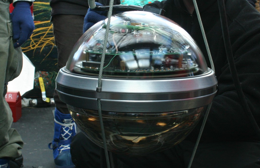
IceCube is a one-cubic-kilometer international high-energy neutrino observatory being built and installed in the clear deep ice below the South Pole Station. IceCube will, when completed in 2011, consist of 86 “strings”, each with 60 optical modules which will detect light from neutrino interactions. As of Spring 2009 59 strings are deployed and currently being operated.
IceCube will open unexplored bands for astronomy, including the PeV (10^15 eV) energy region, where the Universe is opaque to high energy gamma rays originating from beyond the edge of our own galaxy, and where cosmic rays do not carry directional information because of their deflection by magnetic fields. The instrument may, for example, answer the question of whether the fascinating multi-TeV photons originating in the Crab supernova remnant and near the supermassive black holes of active galaxies are of hadronic or electromagnetic origin. IceCube will provide a totally novel viewpoint on the multi-messenger astronomy of gamma ray bursts, which have been identified as a possible source of the highest energy particles in nature.
IceCube also occupies a unique place in the multi-prong attack on the particle nature of dark matter, with unmatched sensitivity to cold dark matter particles approaching TeV masses. As a particle physics experiment with the capability to detect neutrinos with energies far beyond those produced at accelerators, IceCube will join the race to discover supersymmetric particles and the topological defects created in grand unified phase transitions in the early universe. The detection of cosmic neutrino beams would open the opportunity to study neutrino oscillations over mega-parsec baselines.
These exciting capabilities notwithstanding, there should be no doubt, that the true potential of IceCube is discovery. History has not previously disappointed us: the opening of each new astronomical window has led to unexpected discoveries. Hidden particle accelerators may, for instance, exist from which only the neutrinos escape.
More details can be found on the main IceCube website.
What is IceCube?